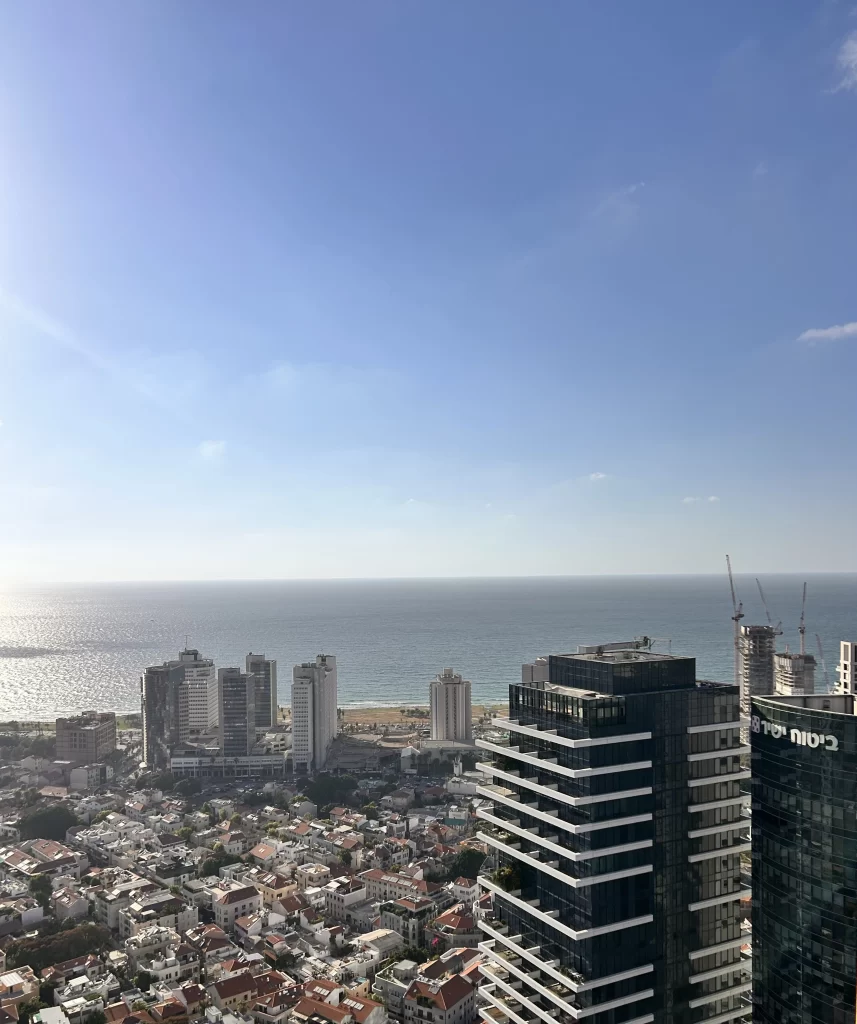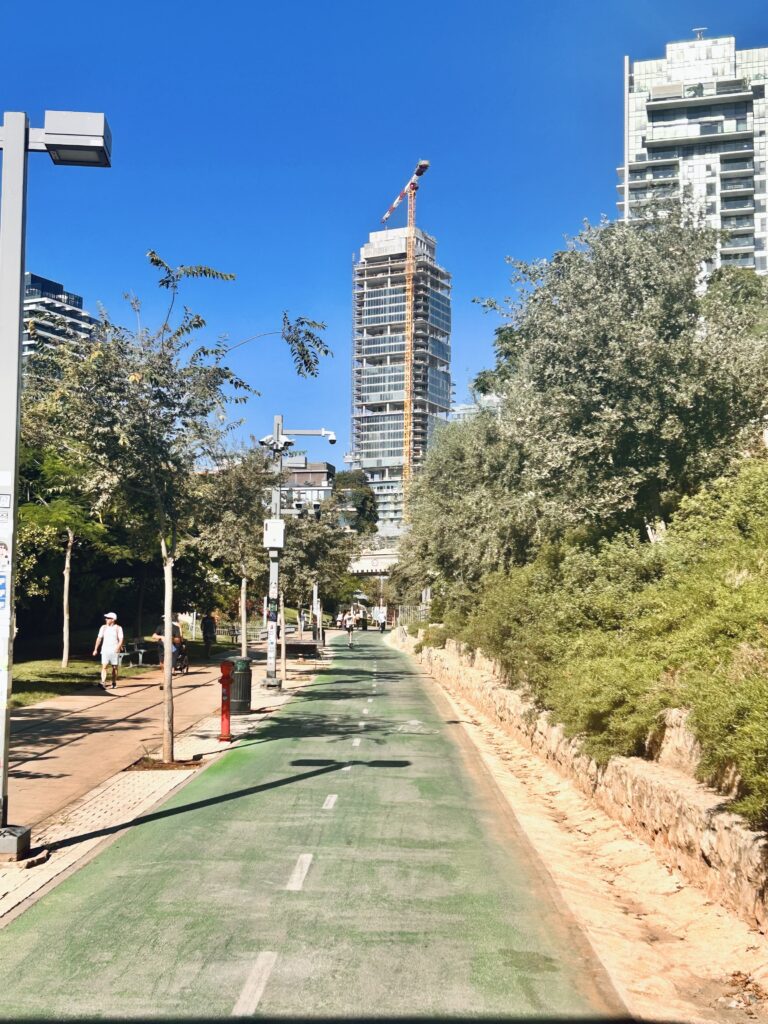
After the Twelve-Day War:
Who Buys Tel Aviv Now?
A scenario analysis of Israeli residential real estate under three post-conflict futures — with a clear, data-backed verdict for USD investors who are paying close attention.
The June 2025 Iran war lasted 12 days. The shekel spiked to 3.82, then recovered to 3.12. Tel Aviv apartment prices are down 2.9% over 12 months. There are 83,920 unsold new units nationwide. But behind them, the construction pipeline is functionally empty through 2027.
Israeli pension funds sell dollars mechanically when equities rise — making the shekel strong today. Any new conflict reverses that instantly. The dollar buyer gets a 3–5 day window to enter at a 15–20% currency discount.
A — Total Victory (25%): USD return +35–50% over 24 months. B — Contained war (45%): USD return +20–35% over 18 months. C — Prolonged attrition (25%): Near-term pain, but the largest eventual rebound of all three.
Buy now, in cash, in North Tel Aviv / Neve Tzedek / Jaffa — only buildings with a mamad. Negotiate 10–15% off ask. Pre-arrange legal structure to execute within 72 hours when the shekel spikes. 2027 will be too late.
The War That Already Happened — And The One Still Coming
Let me be clear about the analytical ground we are standing on. The June 2025 Iran-Israel war — twelve days of missiles, drones, and nuclear facility strikes — was not a hypothetical risk priced into a model. It happened. The USD/ILS spiked from 3.45 to 3.82 in the opening days. And then something nobody predicted with confidence: the shekel collapsed back, harder and faster than any recovery on record. By end of 2025, it was trading at approximately 3.12 — its strongest level since before the October 7 attacks.
This is the market we are sitting in, in February 2026. The ceasefire is holding. Iran’s nuclear program has been set back, by most estimates, a decade. The Tel Aviv Stock Exchange closed 2025 up 51.6%. The shekel is strong. And yet — paradoxically, perversely — Tel Aviv residential real estate has never been more interesting from a dollar perspective.
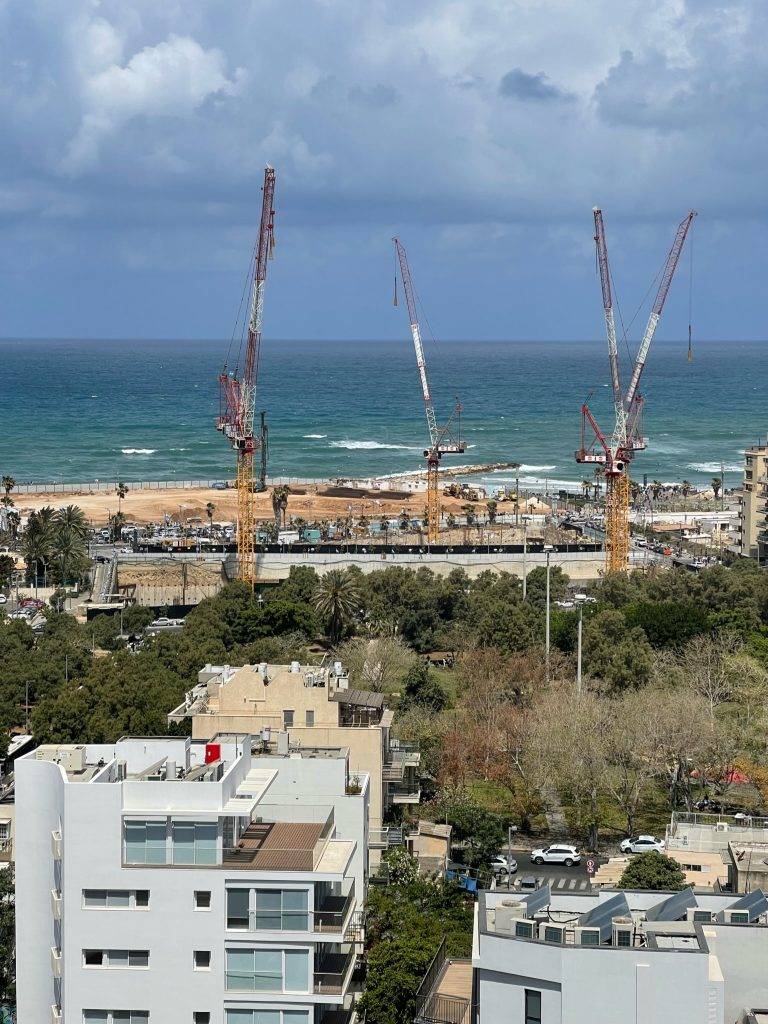
The war did not destroy the market. It split it into two realities that most analysts are still collapsing into one. Today the market looks full: tens of thousands of unsold units, prices soft, developers discounting. Behind that inventory, there is nothing. Construction has stopped. Labor has fled. The pipeline that should be delivering in 2027 and 2028 was never started. The market looks full. It is about to be empty.
This distinction — between existing completed inventory and future pipeline — is the single most important analytical fact in Israeli real estate right now. The 83,920 unsold new homes on the market as of end-September 2025 are real.CBS/BuyItInIsrael↗ They are also the last cohort. Once absorbed, there is nothing behind them. Tel Aviv’s dwelling completions fell 37.7% in 2024 — the steepest decline of any Israeli city.GPG/CBS↗ The labor pool that would build replacements does not exist.
Geopolitics compounds this. Iran’s Supreme Leader approved development of compact nuclear warheads in October 2025. The IRGC has publicly stated a “Phase 2” conflict would last far longer than twelve days. A second conflict is assigned high probability by SpecialEurasia, CFR, and virtually every serious geopolitical intelligence service. The “armed peace” is explicitly transient.
This report solves the following problem: if a second conflict erupts — across three distinct severity outcomes — what happens to Israeli residential real estate in each scenario? And what does a rational dollar-denominated investor do right now?
What Actually Happened: A Rapid Chronology
Israel launches Operation Rising Lion — strikes Iranian nuclear facilities and IRGC command structure. USD/ILS jumps from 3.45 to 3.72 within hours. Real estate transactions freeze nationally.
Iran retaliates with 550+ ballistic missiles and 1,000+ drones. Construction sites go silent. Foreign workers begin departing. The labor shortage — already severe since October 2023 — becomes structural.
United States bombs Fordow and two other nuclear facilities using B-2 Spirit bombers. USD/ILS peaks at 3.82. Global markets reprice Israel risk.
Ceasefire declared. TASE surges. Shekel begins historic appreciation — 3.82 to 3.40 within five days.
CBS publishes Q3 data: Tel Aviv average apartment price ILS 3.68M — down 13% year-on-year, down 12% from Q2 alone. National unsold inventory reaches 83,920 units — 28.8 months of supply. Jerusalem, counterintuitively, rises 9.3% year-on-year to ILS 3.12M average.CBS/Ynet↗
Iranian Supreme Leader approves compact nuclear warhead development. Phase 2 threat made explicit by IRGC-linked press. “Armed peace” declared by all analysts as temporary.
Times of Israel reports from Israel Tax Authority: a 62sqm 3-room apartment on Ben Yehuda Street sold for ILS 4M ($1.246M); an 81sqm 4-room on Beit El Street sold for ILS 2.825M ($875K). Tel Aviv prices down 2.9% over the trailing 12 months.ToI/Tax Authority↗
USD/ILS: 3.12. Tel Aviv average apartment: ILS 3.68M (Q3 2025 CBS). Shekel near multi-year highs. Existing inventory large and visible. Future supply pipeline: functionally zero.
Two Supply Problems. One Market. Most Analysts Only See One.
The confusion in almost all current market commentary comes from collapsing two completely different supply problems into a single narrative. They are not the same thing. Understanding why they diverge — and why both can be simultaneously true — is the entire investment thesis for a dollar buyer right now.
Supply Problem One — Existing completed inventory. As of end-September 2025, there are 83,920 unsold new homes on the Israeli market, up 20.3% from the same month in 2024.CBS/BuyItInIsrael↗ The Tel Aviv district alone holds 20,390 of these.CBS↗ These units exist. They are on the market. Developers are discounting them. This is what the bearish headlines are describing when they say the market is oversupplied. They are correct — as a description of today.
Supply Problem Two — The future pipeline. Behind those 83,920 units, the cupboard is bare. Tel Aviv dwelling completions fell 37.7% year-on-year in 2024 — the sharpest decline of any Israeli city.CBS/GPG↗ New housing transactions in Tel Aviv dropped 33.6% in the first half of 2025.CBS/GPG↗ The construction labor that would build replacements has been progressively eliminated since October 7, 2023, and the June 2025 war accelerated that process. The pipeline that should be delivering 2027–2028 supply was never started.
The market looks full. It is about to be empty. Anyone whose analysis stops at the first sentence has the wrong investment thesis.
This is the structural condition that makes the current moment unusual. Normally an oversupplied market is a clear warning signal. Here, the oversupply is a final buffer before a supply drought. The 83,920 units will be absorbed — the only question is over what timeframe and under what geopolitical conditions. When they are gone, there is nothing behind them. The structural shortage that drove 118% price appreciation between 2006 and 2017 is reasserting itself invisibly, completely out of sight of the current “prices falling” narrative.
Layered on this structural story is the currency mechanism. Israeli institutional investors — pension funds managing hundreds of billions in savings — must rebalance portfolios quarterly. As global equities rise, they sell dollar-denominated assets and buy shekel-denominated holdings. This mechanical dollar-selling strengthens the shekel structurally. After the 2014–2018 pension reform intensified this dynamic, the correlation coefficient between S&P 500 performance and USD/ILS evolved from a negligible ~0.10 before 2008 to a strong negative correlation of -0.60 to -0.72 by 2019–2023. When equities fall — as they do in a geopolitical shock — the mechanism runs in reverse. The shekel weakens mechanically and predictably. And then, once the military outcome becomes clear and equities recover, the shekel strengthens again — often violently.
The June 2025 spike to 3.82 and its rapid collapse to 3.12 was not random. It was mechanical: equity sell-off on war outbreak → pension funds buy dollars → shekel weakens. US joins, conflict ends, equity surge → pension funds sell dollars → shekel strengthens violently. The window at 3.75–3.82 lasted approximately five trading days. The lesson for a dollar investor is not “wait for the next war to spike.” It is: pre-position now, with pre-arranged legal structure, so you can execute in a 72-hour window when the shekel weakens.
What Properties Actually Cost: CBS-Sourced Numbers Only
The following prices are sourced exclusively from the Israel Central Bureau of Statistics (via official publications and aggregators), the Israel Tax Authority transaction database, and the Q1 2025 Tel Aviv market report by OffplanIsrael. All dollar conversions at USD/ILS 3.20, the approximate average rate for the period. Every figure is linked to its source.
| City / District | Avg Apartment Price (ILS) | Approx USD @ 3.20 | 12-Month Change |
|---|---|---|---|
| Tel Aviv–Jaffa | ILS 3,680,000 | ~$1,150,000 | −13% YoY |
| Herzliya | ILS 3,660,000 | ~$1,144,000 | −4.2% YoY |
| Jerusalem | ILS 3,120,000 | ~$975,000 | +9.3% YoY |
| Ramat Gan | ILS 2,920,000 | ~$913,000 | −5.7% YoY |
| Haifa District | ILS 1,880,000 | ~$588,000 | +5.1% YoY |
| Neighborhood | Avg Transaction (ILS) | Approx USD @ 3.20 | Price/sqm (ILS) | Avg Days on Market |
|---|---|---|---|---|
| Neve Tzedek | ILS 8,330,000 | ~$2,603,000 | ILS 70,000–100,000+ | 24 days |
| Rothschild / Lev Ha’ir | ILS 7,910,000 | ~$2,472,000 | ~ILS 82,000 | 27 days |
| North Tel Aviv Ramat Aviv, Tzameret, Bavli |
ILS 6,700,000 | ~$2,094,000 | ILS 65,000–90,000 | 43 days |
| Florentin | ILS 3,940,000 | ~$1,231,000 | ILS 40,000–55,000 | 50+ days |
| Jaffa Noga, Ajami, Port |
ILS 3,520,000 | ~$1,100,000 | ILS 35,000–55,000 | 50+ days |
| Address | Rooms / Size | Sale Price (ILS) | Approx USD | Notes |
|---|---|---|---|---|
| 62 Ben Yehuda St, Tel Aviv | 3-room / 62 sqm | ILS 4,000,000 | $1,246,000 | Built 1970, floor 3 of 6 |
| 12 Beit El St, Tel Aviv | 4-room / 81 sqm | ILS 2,825,000 | $875,000 | Built 1960, floor 4 of 6 |
| 136 HaHagana St, Tel Aviv | 4-room / — sqm | ILS 2,350,000 | $726,000 | South Tel Aviv |
| 7 Avraham Boyer St, Ramat Aviv Gimel | 4-room / 97 sqm | Rental: ILS 11,500/mo ($3,047) | Floor 7, sea view | |
These numbers tell a clear story. The range inside Tel Aviv is vast. An 81sqm apartment on Beit El Street — a 1960-era building, no mamad — sells for ILS 2.825M. A 62sqm apartment on Ben Yehuda — also older stock — sells for ILS 4M, implying ILS 64,500/sqm, because of location and building quality. The mamad premium and the building-age discount are already embedded in these transactions. They will widen, not narrow, as the geopolitical risk profile of Israel is repriced.
Three Wars. Three Futures. One Framework.
The scenarios below diverge on the most important variable: how decisively and how quickly is Iran’s military capacity degraded? The currency, fiscal, and — critically — the two supply dynamics respond differently in each path.
“The Islamic Republic collapses under military pressure and internal uprising. Iran’s nuclear program is eliminated for a generation. A new Middle East order emerges.”
Currency: USD/ILS
Days 1–7: spike to 3.50–3.70 as uncertainty peaks. This is the entry window. Once military dominance is established, the shekel will appreciate violently — to 2.90–3.05, its strongest level in over twenty years. The dollar buyer who converts at 3.60 during the spike and holds through resolution does not just benefit from currency gain. They enter a market that is simultaneously appreciating in local currency terms and revaluing upward in dollar terms. The two effects compound.
The Two Supply Dynamics Under Scenario A
Existing inventory: The 83,920 unsold units absorb within 12–18 months as deferred demand — pent up across 2023, 2024, and 2025 — returns explosively in a climate of genuine peace. Future pipeline: Remains empty through 2027 regardless of political outcome. The labor does not exist to rebuild it quickly. This scenario triggers the most violent demand surge against the thinnest future supply of all three paths. Not being in the market before 2027 is, under this scenario, the most costly error a long-horizon investor can make.
Fiscal Dimensions
A decisive conflict under 3 weeks costs approximately $3–5 billion in direct military expenditure — absorbable. The peace dividend is structural: country risk premium collapses, sovereign bond yields compress, tech sector FDI surges. This scenario rerates Israel’s entire investment thesis, not just the real estate market.
“A second conflict lasts 10–21 days. Iran’s missile program is further degraded. No regime change, but a fundamentally altered deterrence framework and a negotiated nuclear limitation.”
Currency: USD/ILS
Days 1–7: spike to 3.55–3.75. The 2025 playbook repeats. Post-ceasefire recovery is less dramatic than Scenario A — settling in a 3.15–3.30 range, not sub-3.10. This is still a meaningful 12–18% currency entry advantage for dollar buyers who act in the opening week. Bank of Israel uses its approximately $210 billion FX reserve war chest to ensure orderly depreciation; no free-fall.
The Two Supply Dynamics Under Scenario B
Existing inventory: Absorbs more slowly than Scenario A — demand recovery takes 9–12 months rather than 6. Buyers return cautiously. Future pipeline: This is where Scenario B becomes more damaging than Scenario A for supply. Each additional month of construction freeze under a second conflict pushes the already-depleted pipeline further back. A 15-day second conflict adds roughly 2–3 months of effective construction stoppage on top of the existing labor shortage. The supply drought of 2027–2028 becomes more severe, not less. The mamad bifurcation deepens permanently: buildings without safe rooms trade at a widening discount as the Israeli consumer’s risk calculus is, for the second time in two years, forcibly updated.
Fiscal Dimensions
A 15-day second conflict at June 2025 intensity: approximately $5–8 billion total direct cost. Debt-to-GDP creeps to 73–75%. Rating agencies monitor but do not act. Purchase tax headwinds accelerate for local leveraged buyers — largely irrelevant to a foreign cash buyer.
“No decisive military outcome. Iran proves more resilient than expected. Fighting extends beyond 30 days. US support is limited. The conflict becomes a grinding strategic standoff.”
Currency: USD/ILS
The shekel breaks 3.90 within 10 days and holds there. Bank of Israel activates its $210 billion reserve war chest — but with a sustained conflict, reserve drawdown itself becomes a market concern. By week three, USD/ILS stabilizes in a 3.80–4.10 band. This is actually the scenario with the most raw dollar entry advantage — but executing a property transaction while missiles are actively falling is practically impossible. This is the scenario to fear as an existing leveraged owner, and to prepare for patiently as a cash-funded prospective buyer.
The Two Supply Dynamics Under Scenario C
Existing inventory: Frozen. No transactions. No financing. No closings for the duration. Future pipeline: Permanently destroyed for this cycle. Labor that departed in 2023, partially in June 2025, now leaves Israel entirely. Construction costs — already elevated by labor scarcity — surge further. Any near-term recovery in NIS prices is delayed by 6–18 months. But this is also the scenario where the ultimate supply destruction is most severe. Demand deferred across three separate conflict cycles returns in a single compressed wave against a supply base that cannot respond. The 2006 Lebanon War precedent: northern property fell 12–18% during the conflict and recovered 40%+ within 36 months. Tel Aviv barely moved during the war itself. Scenario C’s eventual recovery, when it comes, is the most explosive of all three paths.
Fiscal Dimensions
The Gaza conflict cost Israel $67+ billion over two years. A sustained Iran conflict of similar duration would be economically severe: debt-to-GDP hits 78–82%, rating agencies downgrade, mortgage programs freeze. This is the one scenario where leverage is genuinely dangerous. Cash buyers with a long horizon are the only viable strategy.
What History Actually Shows
The Israeli real estate market has been conflict-tested more systematically than any comparable developed economy. The record is consistent: wars produce temporary entry windows, not sustained long-term declines.
| Conflict | Tel Aviv Impact (Peak) | Market Freeze | 24-Month Recovery | USD/ILS Behavior |
|---|---|---|---|---|
| Second Intifada 2000–2005 |
−8 to −12% | 18–24 months | +22% (2006–2008) | Gradual weakness, then recovery |
| 2006 Lebanon War 34 days |
−12–18% (North only) Flat in Tel Aviv |
2–3 months | +18% (2007–2008) | Brief spike, rapid recovery |
| Operation Protective Edge 2014, 51 days |
−3 to −5% | 2 months | +12% | ILS weakens ~8%, then recovers |
| Oct 7 / Gaza War 2023–2025 |
−8–18% worst months | 6–12 months | +7.8% in 2024 despite war | 4.00 peak → 3.12 by end 2025 |
| June 2025 Iran War 12 days |
−13% YoY by Q3 2025CBS/Ynet↗ | 3–4 weeks active | Projected: recovery 2026 | 3.82 peak → 3.12 in 6 months |
The pattern holds across every conflict type and duration. Every single one was followed by meaningful price appreciation within 24 months. The investors who generated the strongest returns were not those who waited for the all-clear. They acted in the fog. The price trough is always during the conflict. By the time the ceasefire is declared and the narrative turns euphoric, the opportunity is already in the rearview mirror.
Buy Now. Not Later. Here Is Exactly How.
The market is broadcasting everything you need to hear — if you are reading it from the right vantage point. Local buyers are paralyzed by war fatigue, mortgage rates, and psychological exhaustion. Foreign buyers are spooked by headlines. The narrative is “prices are falling.” All of these things are creating precisely the conditions the historical record identifies as preceding the sharpest appreciation cycles in Israeli real estate history.
Every structural element points the same direction for a cash dollar buyer. The shekel is near its four-year high against the dollar — any conflict implies initial shekel weakness and therefore a lower dollar entry price. Tel Aviv prices fell 2.9% over the past 12 months and are negotiable at 10–15% below asking right now.ToI/CBS↗ The existing inventory of 83,920 units is the last cohort — behind it, the pipeline is empty.CBS↗ And the mamad premium is a permanent structural repricing that will only grow.
My recommendation is unambiguous: a dollar-denominated buyer should move now, in February 2026, before the next conflict triggers shekel weakness and before the supply drought becomes obvious to everyone else.
Buy in cash. Target North Tel Aviv (ILS 6.7M average), Neve Tzedek (ILS 8.33M average), and Jaffa (ILS 3.52M average) — the neighborhoods with the deepest foreign buyer liquidity and the fastest historical post-conflict recovery profiles. Focus exclusively on buildings with mamad. Negotiate hard: 10–15% below asking is achievable today. Denominate everything in shekels; the currency advantage at purchase is your first layer of return.
If a second conflict erupts before you close: do not panic. Do not cancel. Renegotiate harder. The June 2025 precedent showed the market back at pre-war levels within six months. A well-structured, cash-funded entry into the most supply-constrained major city in the developed world should not be derailed by a missile barrage.
The only buyer who should wait is one taking on significant leverage in a scenario-C world. For cash-funded, long-horizon, dollar-denominated investors: the time to buy Tel Aviv real estate is right now, while everyone else is still watching the news.
The Checklist: What to Buy, Where, and at What Price
Tier 1 — Buy Now, Scenario-Agnostic
These positions work in Scenarios A, B, and C. All average prices from Q1 2025 transaction data via OffplanIsrael / Israel Land Authority.↗
| Neighborhood | Q1 2025 Avg (ILS) | Approx USD | Mamad Status | Target Discount Now | 2027 Outlook |
|---|---|---|---|---|---|
| North Tel Aviv Ramat Aviv Gimel, Tzameret, Bavli |
ILS 6,700,000 | ~$2.1M | New towers ✓ | 8–12% off ask | +20–30% |
| Neve Tzedek Boutique, highest foreign demand |
ILS 8,330,000 | ~$2.6M | Verify per building | 10–15% off ask | +20–28% |
| Old North Ben Yehuda, Dizengoff, Basel |
Market est. ILS 4–6M | ~$1.25–1.9M | Selective — verify | 10–15% off ask | +15–22% |
| Jaffa Noga, Ajami, Port area |
ILS 3,520,000 | ~$1.1M | New developments ✓ | 12–18% off ask | +22–30% |
The Mamad Premium — A Permanent Structural Shift
The mamad — the reinforced protected room — has moved from a legal requirement to the first question every buyer asks. Buildings without one trade at a 15–20% discount to equivalent inventory with one. This gap will widen, not narrow. The Israeli consumer’s risk calculus has been permanently altered by two major conflicts in two years. Any building lacking a mamad should be modeled with a structural 20% haircut as a floor — not a ceiling. Do not buy without one unless acquiring specifically for pinui-binui (demolition and rebuild), in which case the discount must compensate accordingly.
What to Absolutely Avoid
Any building without a mamad — unless buying for urban renewal. Any project with developer financial stress or unresolved construction. Leveraged positions using Israeli shekel mortgages as a dollar-income investor: the interest rate risk combined with scenario-C currency exposure creates a double downside that erodes returns in the one scenario where they are already under pressure. Properties in northern Israel outside the greater Tel Aviv metropolitan area until Scenario A or B is confirmed.