The Tel Avivi · Market Intelligence · June 2026
The two-speed market: what's really happening in Tel Aviv real estate
Israeli home prices are falling. Tel Aviv luxury just set an all-time record. Both sentences are true, and if that confuses you, you're reading the wrong headlines. Here is the full picture — every number verifiable against the Tax Authority's own records, most of them in our live transactions tool below.
June 2026 · 14 min read · Data: CBS, Bank of Israel, Israel Tax Authority
In January, a client called me from New York. "Eddy," he said, "I read prices are finally coming down. I'll wait another year." I told him what I'll tell you: in his currency, Tel Aviv had just become eighteen percent more expensive while he was waiting for it to get cheaper. Silence on the line. Then: "Walk me through it."
This article is that walk-through. It's written for the buyer I know best — the diaspora family or investor weighing a Tel Aviv apartment as a foothold, an inheritance, an insurance policy, or all three. I'm not going to sell you a market. I'm going to show you two markets wearing one headline, with the data to prove it — and at the bottom of this page you'll find our live transactions tool, built on the Tax Authority's own records, so you can check every claim I make against reality. That's the standard this market deserves and almost never gets.
The headline number is lying to you
What the CBS data actually saysStart with the official record. Israel's Central Bureau of Statistics says national home prices fell 1.2% year-over-year as of early 2026, with declines in nine of the last twelve months. Tel Aviv district: down 3.5%. Jerusalem, interestingly, up 4.2% — the only major district rising. The average Israeli apartment now costs about ₪2.33 million; the average Tel Aviv apartment about ₪4.59 million.
So the correction is real. Two years of 4.5% interest rates, a multi-front war, and a record glut of unsold new construction did exactly what economics textbooks say they should. If you stop reading here, the conclusion writes itself: wait.
Here's why stopping here is the most expensive mistake a dollar-based buyer can make: that decline is measured in shekels. You don't earn in shekels. And the shekel just had its strongest run in a generation.
Home prices, year-over-year — the official picture
CBS transaction data, Feb–Mar 2026 vs. Feb–Mar 2025, by district. Source: Times of Israel / CBS.
Sources: Times of Israel — Housing snapshot, May 2026 · CBS Index of Dwelling Prices
Your currency changed the math
The shekel effect, quantifiedWhile Israeli headlines tracked the decline, the shekel appreciated roughly 20% against the dollar in a single year, touching levels near ₪2.88–3.00 to the dollar — territory last seen in the 1990s. Globes called it; the JTA wrote about Americans in Israel feeling squeezed by it. For a buyer holding dollars, pounds or euros, this is the entire story.
Run the arithmetic on a ₪10 million Tel Aviv apartment. A year ago, at ₪3.6 to the dollar, it cost about $2.78 million. Today, after a 3.5% shekel-price decline but at ₪2.95 to the dollar, the same apartment costs roughly $3.27 million. The "falling market" raised your price by about 18%.
I've watched this exact mechanism punish patient buyers for eighteen months. The lesson is not "panic buy." The lesson is that for a foreign buyer, the currency is half the trade — and anyone advising you on Israeli property without a currency view is doing half the job. When the shekel is this strong, the negotiating leverage of a soft local market matters more, not less: it's the one lever that still works in your favor.
One apartment, two stories — ₪10M of prime Tel Aviv over 12 months
Illustrative path between verified endpoints: TLV district −3.5% YoY (CBS); USD/ILS ≈3.6 → ≈2.95 (Globes, ~20% appreciation). Toggle the currency. Same asset.
Sources: Globes — Shekel nears 2.90 · JTA — The stronger shekel problem
Every number in this article can be checked against the Tax Authority's records. Our live transactions tool is further down this page.
Jump to the dataThe luxury segment didn't read the memo
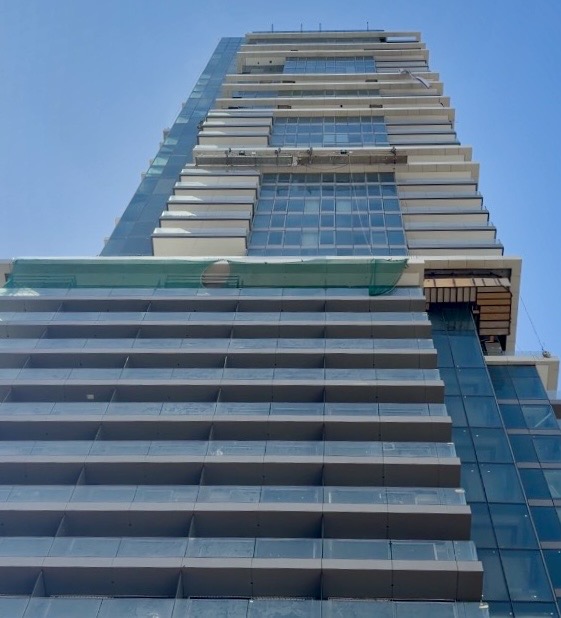
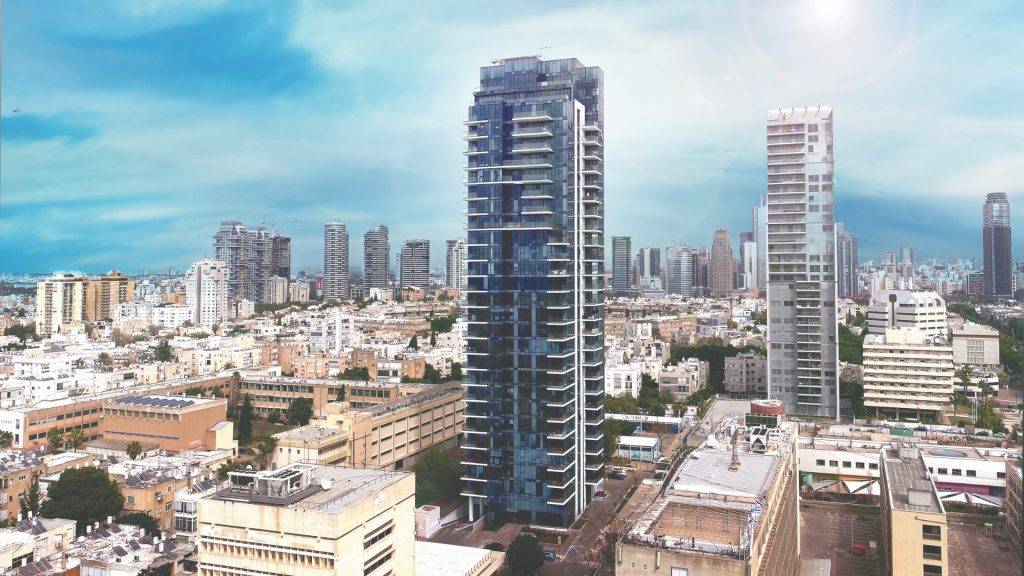
Records on RothschildNow the second speed. While the broad market corrected, 2025 was a record year at the top — and the records were not set by Israelis. In November, a foreign buyer purchased an entire ~600 m² floor of the Rothschild 10 tower for about ₪106 million — roughly ₪176,000 per square meter. In June, a 313 m² apartment on the 35th floor of the same tower closed at ₪51 million. At Rothschild 30, a foreign resident paid ₪37 million for 356 m² on the 26th floor. Ynet's year-end review noted something I can confirm from the ground: virtually every super-luxury Tel Aviv deal of 2025 happened in one micro-market — south Rothschild.
Who is buying? The Ministry of Finance data answers precisely. Foreign residents bought 187 apartments in November 2025, up from 140 a year earlier. In Q1 2026, Americans made 49% of foreign purchases — 238 apartments — while French and British shares rose. And behind the transactions stands a demographic wave: 21,900 olim arrived in 2025, with U.S. aliyah up 12%, France up 45%, and the UK up 19%. Rising antisemitism in the West is converting "someday" buyers into "this year" buyers — I see it in every intake call, and the Chief Economist's review says demand is concentrating in exactly one asset type: unique, irreplaceable, prime.
This is why the headline index and the luxury market diverge. An index averages 85,000 surplus apartments in the periphery with eleven floors of Rothschild frontage. Scarcity doesn't average.
Price per m² — the city, the prime, and the records
Indicative trading ranges by neighborhood (early 2026, The Tel Avivi market reading) against verified 2025 record prints on the Rothschild corridor. Hover the bars.
Sources: Ynet — Israel's biggest deals of 2025 · Buyitinisrael — Most expensive deals · JPost — Aliyah 2025 · Ynet — Where foreign buyers buy
The leverage window
Rates turning, inventory at recordsHere is the part the luxury records obscure: for everything that is not irreplaceable, this is the best buyer's market in a decade. The stock of unsold new homes sits around 85,000 units — a record. Developers carrying two years of financing costs are offering payment structures I haven't seen since 2015: 10/90 schedules, absorbed purchase taxes, fit-out credits. They won't call it a discount. It is one.
And the rate cycle just turned. The Bank of Israel cut in January 2026 — its first move in nearly two years — and again on May 25, to 3.75%. Globes' analyst consensus still sees prices soft into late 2026, which I broadly share for the mid-market. But understand the sequence, because it always plays out the same way: rates fall, mortgage demand returns, inventory clears, and the developer concessions disappear before the index turns positive. The published index is a rear-view mirror; the concessions are the windshield.
So the window is now — not because prices will spike next quarter, but because leverage like this doesn't coexist with falling rates for long. The buyers who did best after 2008 and after 2020 were not the ones who called the bottom. They were the ones negotiating while everyone else was waiting for permission from a headline.
Sources: Bank of Israel — May 25, 2026 rate decision · Globes — Analyst outlook · Times of Israel — First cut in two years
Where, exactly
The map that mattersTel Aviv is not one market; it's a dozen micro-markets that happen to share a beach. The map below is the one I draw on napkins for clients. Click a marker: each carries the current indicative range and my one-line read. Three things to notice. First, the entire super-luxury record book of 2025 sits inside one polygon — south Rothschild. Second, the neighborhoods diaspora buyers actually live in — the Old North around Bazel, Neve Tzedek — are scarcity markets where quality stock trades off-market before it's ever listed. Third, the value frontier (Florentin, the Kerem fringe, Noga) is where the next decade's appreciation argument is strongest, and where building-by-building selection matters most.
Don't take my word for it
Live Tax Authority data, in EnglishEverything above is an argument. What follows is evidence. Every closed transaction in Israel is recorded by the Tax Authority and published on nadlan.gov.il — in Hebrew, in a format only a bureaucrat could love. We built the tool below to fix that: the last 12 months of real Tel Aviv transactions, translated to English, filterable by neighborhood and bedrooms, in shekels and dollars, mapped to the building. It is, as far as I know, the only tool of its kind in English. Use it. Check my numbers. Then check the street you're considering.
The playbook
Five moves, in orderFix your currency framework before you look at a single listing.
Decide your all-in dollar (or euro/sterling) budget and your FX assumption. The shekel at ~2.95 is the strongest since the nineties; whether you hedge, convert in tranches, or wait on a pullback is a bigger decision than which balcony you prefer.
If you're buying mid-market: attack the unsold inventory.
85,000 unsold new units is not a statistic, it's a term sheet. Payment schedules, tax absorption, upgrades — everything is negotiable right now, and won't be once the rate cuts work through the system.
If you're buying prime: optimize for access, not timing.
The 2025 record book was written in one micro-market by buyers who were shown assets before they were listed. In scarcity segments, the discount isn't on the price — it's on being in the room.
Structure the tax before the contract, not after.
Foreign residents pay 8%/10% purchase tax with brackets frozen through 2027; the oleh track can change the math materially. The timing of an aliyah relative to a purchase is a six-figure decision. Take legal advice early — we work with the best.
Talk to someone whose only client is you.
We are buy-side only: no developer inventory, no listing conflicts, no commissions from the other side of the table. Research, selection, negotiation, legal and tax coordination, through to keys and management. A 30-minute call costs nothing and will save you from at least one expensive assumption — I guarantee that much.
Questions we get every week
Is now a good time to buy property in Israel?
Wrong question — the right one is "in which currency and which segment?" In shekels, the broad market is soft (−1.2% nationally, −3.5% Tel Aviv YoY) with record unsold inventory: real leverage. In dollars, prime Tel Aviv rose ~18% over the year because of the shekel. Dollar buyers waiting for a bottom have been paying for the wait. Get the brief for the full framework.
Can foreigners buy property in Israel?
Yes — no ownership restrictions. Purchase tax for foreign residents is 8% up to ~₪6.06M and 10% above (brackets frozen through 2027). Banks finance non-residents up to roughly 50%. The entire process can be done from abroad with power of attorney; our clients close from New York, London and Paris without flying for paperwork.
What does a square meter cost in Tel Aviv in 2026?
Indicatively: ₪50–70k in the central residential core, ₪70–100k in the Old North, ₪70–120k in Neve Tzedek and on Rothschild — and the 2025 record prints on Rothschild 10 reached ~₪163–176k/m². Ranges are averages; the real price is negotiated building by building. Verify any street in our live transactions tool.
Where are American and European buyers actually buying?
Per Ministry of Finance data, foreign purchases concentrate in Tel Aviv, Jerusalem and Netanya, with Herzliya Pituach strong at the top end. Americans were 49% of foreign purchases in Q1 2026; French and British shares are rising. In Tel Aviv specifically: south Rothschild for trophies, Old North and Neve Tzedek for living.
Will prices crash when the unsold inventory clears?
The consensus (Globes) sees softness into late 2026, not a crash — and the Bank of Israel is now cutting, which historically clears inventory through volume rather than price collapse. The structural picture is unchanged: a small country, a supply-constrained coastal core, and a global diaspora that treats Israeli property as more than an investment.
How is The Tel Avivi different from an agency?
We never sell inventory. We work one side of the table — yours: search, building-level analysis, negotiation, lawyers and tax structuring, keys, then management if you're abroad. The transactions tool on this page is a fair sample of how we think: data first, then conviction.
The 2026 Tel Aviv Investor Brief — prices per m², tax math, buying from abroad. Free.
Get the brief